Camas-Washougal logo tag

Leaders update timeline for I-5 Bridge replacement, say first phase could be open to drivers by 2034

Adding light rail, other improvements will follow when money is available

By
timestamp icon
category icon Clark County, Government, News
Interim Interstate Bridge Replacement Program Administrator Carley Francis, right, answers a question from a reporter Tuesday during a press conference at the Interstate Bridge Replacement Program headquarters in downtown Vancouver. (Taylor Balkom/The Columbian)

Construction of a replacement Interstate 5 Bridge will unfold in phases, given that the project has less than $5.5 billion in hand to cover a cost expected to exceed $13 billion.

The first phase will deliver the actual bridge, which could be open to drivers, bicyclists and pedestrians as soon as 2034. Light rail trains headed to the Vancouver waterfront and removal of the existing I-5 Bridge spans will follow, but the remainder of the 5-mile corridor improvements will need to wait until the program finds additional revenues.

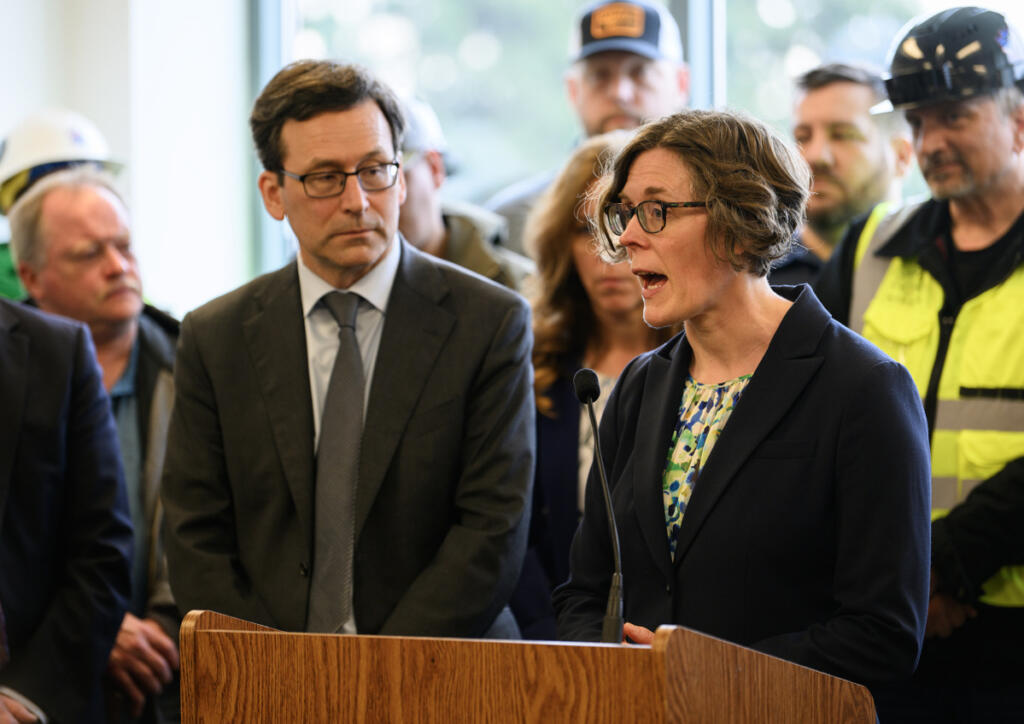
Interstate Bridge Replacement Program leaders delivered the updated timelines to the program’s Executive Steering Group Tuesday afternoon following a press conference with Washington Gov. Bob Ferguson that morning.

Vancouver Mayor Anne McEnerny-Ogle, a steering group member, asked Carley Francis, the program’s interim administrator, to explain the expected phases in greater detail during the steering group meeting.

“We know that we have a long road ahead to get Phase 1 done and to bring light rail over here to get on and off the bridge, but we’re excited to get things moving along,” McEnerny-Ogle said.

Francis said the first phase is a $5.9 billion step that will select a contractor and design the fixed-span replacement bridge in 2027 and begin construction of the new bridge in 2028. She said it would likely take an additional six to seven years to open the new bridge to traffic. The bridge will be built to accommodate light rail trains, but extending TriMet’s MAX trains from Portland to Vancouver won’t happen immediately. Francis told the steering group that construction on the light rail infrastructure will likely begin in 2030 with an opening date in 2036.

The final piece of the bridge replacement’s first phase, Francis said, involves removing the existing 109-year-old, seismically unsound I-5 Bridge spans.

“The bridge removal can start in 2035, and I think it is a couple years’ process to get that completed,” Francis said.

The rest of the project — improving the rest of the 5-mile corridor surrounding the bridge and extending light rail as far as Evergreen Boulevard in Vancouver — could stretch out another decade after the bridge opens, depending on funding.

McEnerny-Ogle said she wants the public to understand that although costs have more than doubled from the program’s 2022 estimate of $5 billion to $7.5 billion, and the timeline for the entire project now extends to 2045, program leaders and partners from Oregon and Washington are committed to delivering the most critical elements much quicker.

“I believe after this morning’s press release, the headlines on all of these newspapers and television stations will be the bigger number, 2045, and people will have that stuck in their brain,” McEnerny-Ogle said. “But we’re talking about Phase 1, the bridge, and that number is 2034. So, as the message gets out, let’s make sure people understand we’re building a bridge and that this is the cost we know right now based on risk and inflation.”

Francis said it will cost $7.65 billion to complete the core set of projects in the first phase. Building the new bridge and connecting it to I-5 will eat up $5.9 billion.

The program has $5.5 billion in dedicated funding, including $1 billion each from the states of Oregon and Washington and more than $2 billion in federal grants. Francis said the program also expects to raise $1.25 billion through tolling on the current and future I-5 bridges.

Building the replacement bridge and connecting it to the highway will cost around $450,000 more than the program’s current revenues. Bringing light rail across the bridge to the Vancouver waterfront and removing the existing bridge will increase that revenue gap to $2.2 billion.

Francis said Tuesday afternoon that strategies for closing the revenue gap include securing a $1 billion federal transit grant, pursuing other federal grants, working with the states on cost-saving measures and other funding opportunities, and a heavier reliance on tolling revenues.

Get the latest headlines in your email every week!

This field is for validation purposes and should be left unchanged.

A bistate tolling subcommittee with two members each from Washington and Oregon will soon recommend toll rates and policies to transportation commissions in both states. According to information provided during a September legislative committee meeting with the Interstate Bridge Replacement Program’s executive team, Washington and Oregon officials are considering four tolling scenarios that range from $1.55 to $4.70, as well as exemptions and discounts for certain groups including tribal members and low-income residents on both sides of the bridge.