Camas-Washougal logo tag

Orca found, killed in Columbia Slough in 1931 buried there

Is there a whale buried in rural Clark County? The short answer is yes. The long answer has captivated Clark County residents for almost a century.

By
timestamp icon
category icon Clark County, Life, News

Is a long-dead whale buried on Livingston Mountain in east Clark County?

The short answer is yes. The long answer involves a series of events that eventually became a dimly remembered local legend, passed on from generation to generation. The story of Ethelbert the whale (or Oswald, to people on the Washington side of the Columbia River) has lived a kind of cultural half-life — it never fully disappears, but it’s never fully vivid, either.

“I’m captivated by this weird loss of memory that the community has sometimes,” said Brad Richardson, the executive director of the Clark County Historical Museum. “It’s like, how did you forget a whale? It’s like misplacing an elephant.”

Richardson grew up in east Clark County and is one of the county’s preeminent historians, but even he didn’t know that a whale is buried in rural Camas until he moved to Livingston Mountain in 2021.

“I was at a neighbor’s birthday party,” Richardson said. “One of the neighbors, who knew I was a local historian, said to me, ‘Do you know there’s a whale here?’ And I went, ‘What? You have to be kidding me.’ ”

The legend of Ethelbert the whale has been meticulously uncovered by local historians such as Samantha Smith during the past several decades.

“This story is bigger than people think,” said Smith, a Clark County Historical Museum researcher. “It’s bonkers bananas. It was an actual event that everybody was absolutely into, the whale-mania, and then eventually the details were all but forgotten. What remains is a huge local legend. It’s almost like the ‘boogieman.’ ”

Astonishing sight

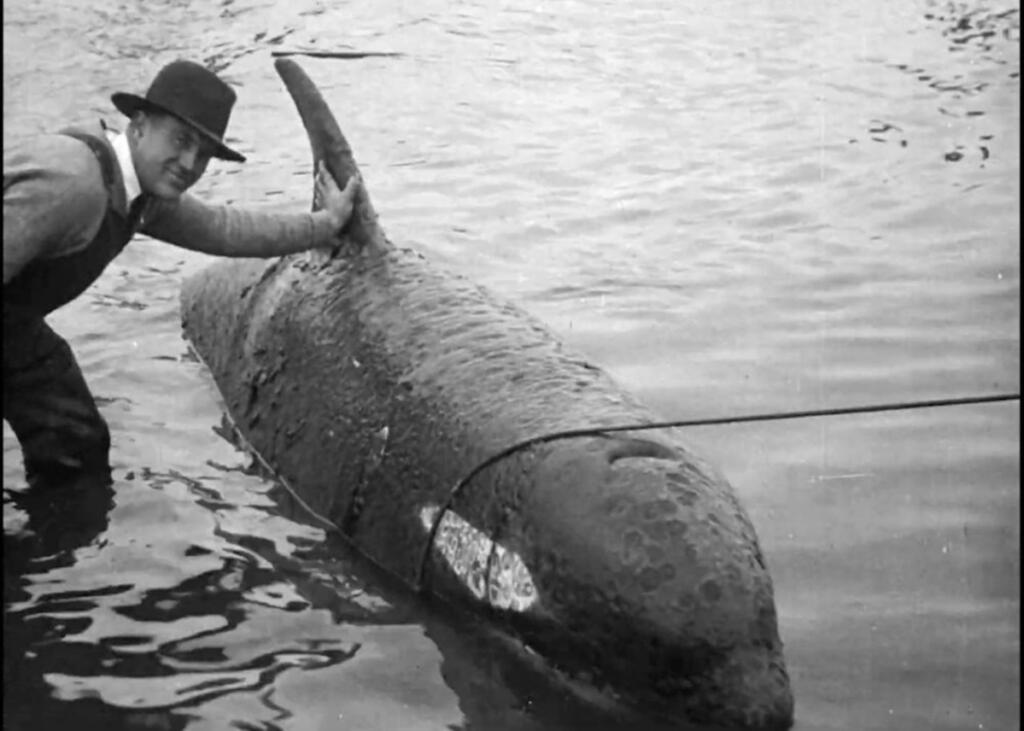
On Oct. 13, 1931, Portland-area residents awoke to an astonishing sight — a juvenile whale swimming in the waters of the nearby Columbia Slough. The 4-year-old orca had somehow traveled nearly 100 miles upriver from the Pacific Ocean through the Columbia River. Crowds started gathering along the banks of the river to watch the orca surface and spout.

Local newspapers quickly turned the strange visitor into a major celebrity. The whale’s presence attracted thousands of people, leading to massive traffic jams. Residents looking to make a quick buck started selling hot dogs and popcorn. And local businesses began running advertisements with slogans such as “A whale of a sale” and “What a whale of a difference a few cents can make.”

“People were so into this. It was total hysteria,” Smith said. “It was nationwide news.”

As the days passed, however, concern grew about the whale’s condition. Some observers believed Ethelbert was becoming weak or sick from the slough water, which was polluted and far from the saltwater environment orcas require.

On Oct. 24, St. Helens, Ore., resident Edward Lessard and his son Joe set out in a boat and killed the whale with a harpoon. Edward Lessard told reporters that he previously hunted whales commercially and was “interested in them,” and that he killed the whale for “scientific purposes.”

“It was the quickest killing I ever made,” Edward Lessard told The Oregonian. “Usually it takes half a day or a day to kill a whale. This one was dead as a doornail in less than five minutes.”

The whale’s carcass was hauled ashore and briefly displayed to the public, drawing both crowds and criticism. Authorities arrested the Lessards, kicking off a legal case that became complicated because existing fishing laws did not clearly apply to whales.

The legal arguments reached a bizarre peak as the Bible was used in court to argue whether Ethelbert was technically a fish or a mammal to determine which laws applied. Litigation continued for years until the Oregon Supreme Court finally ruled in early 1934 that the state of Oregon would maintain ownership of the whale.

Edward Lessard didn’t give up, however. He eventually regained possession of the whale after a lengthy legal dispute with the state of Oregon, and for several years transported the carcass, preserved in a custom-built metal tank filled with formaldehyde, around the United States as a traveling exhibit.

Eventually the unusual show faded from public attention and Edward Lessard brought the whale to his St. Helens home in 1940. Nine years later, residents started complaining about the whale’s “perfume,” or smell of decay, and Oregon health officials ordered Lessard to bury the carcass. Instead, he moved it to his property on Livingston Mountain in Camas, where it sat above ground for almost 25 years.

“Hikers would come across it and get scared by it,” Smith said. “That’s how the legend grew.”

The whale was finally buried on the mountain in 1973 after Edward Lessard’s death. Its exact location remains a mystery to this day.

At the time, the most captivating thing about the story was the novelty of having an orca in the slough of the Columbia River, Smith said.

“That’s not something that we see very often,” she said. “But now it’s the fact there’s a whale buried up on a mountain. How did it get there? Why is it there? It’s just one of those stories that makes you go, ‘Hold up, back up, say that one more time. I don’t think I heard you correctly.’ ”

Get the latest headlines in your email every week!

This field is for validation purposes and should be left unchanged.