Camas-Washougal logo tag

Sign of spring on Columbia with salmon seasons set

One guide says water conditions could be ideal for fishing

By
timestamp icon
category icon Clark County, Outdoors, Sports
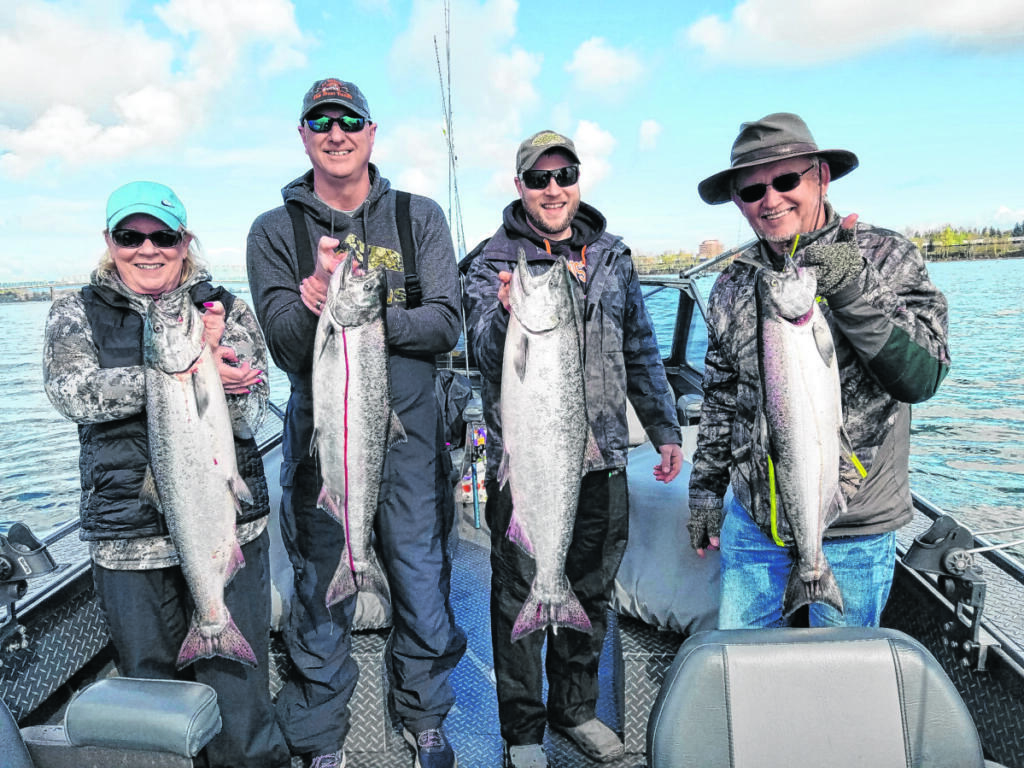
These fishers got their spring Chinook while fishing the Columbia River with Matt Halseth. Anglers are hoping for better river conditions this year, since high, cold water bedeviled the fishing in 2025. (Photo courtesy Matt Halseth)

Oregon and Washington State fisheries managers followed the staff recommendations and anglers will get 39 days to fish the main stem Columbia River for spring chinook this season.

The spring chinook seasons, depending on section of river, of March 1 to April 8 and April 1 to 26 plus May 2 were set during a joint state hearing on Feb. 19.

The projected number of adult spring chinook to enter the Columbia River this year is 147,300, which is less than the actual return in 2025 of 154,703 adults. However, it is better than the 10-year average of 126,248. It is also larger than the 2026 forecast of 122,500.

The lower Columbia River below Bonneville Dam is set to see the fishery extend to April 8, with a six fish limit, of which two adults may be kept, only one of which may be a chinook. Only adipose fin-clipped chinook and steelhead may be retained.

The season will remain open until March 31 under permanent rules from the mouth of the Columbia River to the Interstate 5 bridge.

Only bank angling is allowed from Beacon Rock to the deadline at Bonneville Dam.

In the Columbia from the Bonneville Dam upstream to the Washington-Oregon border, anglers will see a season from April 1 through 26, with an additional day of fishing on May 2. The same limits apply. Only bank angling is allowed from the Bonneville Dam up to the Tower Island power lines, approximately six miles below The Dalles Dam.

“This year’s upriver spring chinook forecast is improved compared to last year’s forecast and is above the 10-year average, which allows for some additional fishing opportunity early in the season,” said Ryan Lothrop, Columbia River fisheries manager with the Washington Department of Fish and Wildlife, in the news release.

“We’re committed to preserving and protecting the resource while providing sustainable recreational opportunities consistent with our management objectives. That balance drives how we set these fisheries.”

Recreational anglers below Bonneville Dam are projected to harvest approximately 5,800 adult chinook. Another 700 adult spring chinook are expected to be harvested above Bonneville Dam prior to the run-size update.

Dam counts and hatchery returns will be monitored, and the forecast run will be updated as necessary. The U.S. v. Oregon Technical Advisory Committee typically provides an initial run size update in May.

Once the fisheries close, state fisheries managers will review catch data and decide if there is enough leeway to add some additional fishing days.

The Select Areas, including the Deep River area, will be under the same rules for limits as the main stem Columbia when it is open. When the main stem is closed, the Select Areas will operate under the permanent regulations.

Preseason forecasts for the tributaries are strong enough that fishers will see retention allowed in the Cowlitz, Lewis, and Kalama rivers.

The Lewis River is projected to get a return of 5,000 adults, which would top the 2025 actual return of 4,719 adults. The Cowlitz River could see as many as 9,300, which would be a drop from last year’s actual return of 11,377. Likewise, the Kalama River projection is for a return of 3,300 to the tributary, which is under the actual 2025 return of 4,235 spring chinook.

The tributary returns are strong enough that there will be no need to close the main stem Columbia anywhere to protect hatchery brood stock collection, as has happened a few times in the past.

A guide’s view

Oregon fishing guide Matt Halseth of Matt Halseth Guide Service, likes the look of the coming season.

“The forecast is about the same as last year,” he said, “but I think the conditions will decide if it’s a good year.”

Columbia River conditions last year, with high water and cold temperatures, kept the fishing difficult. Halseth is more optimistic for this spring.

“The water should stay low and clear, since we do not have much snowpack,” he said.

He also thinks the water temps will be better, and that means better fishing, sooner.

“With the warm water the fish will come in earlier,” Halseth said. “When it’s sub 50 degrees they just don’t move as much. You get 51, 52 degrees, and its go time.”

There are other considerations, including the smelt run.

“You have to watch how the smelt run comes in,” he said. “When the river is chock full of smelt, it’s hard to get the fish to notice your bait.”

Also, if the fish are tempted to bite, all they have to do is turn their head for a smelt meal.

Halseth will wait until April to start fishing the main stem, because that is when the run usually is coming in strong. Although, even then he weighs the reports he is hearing from other guides as to how good the fishing is. If it is poor, he offers his clients an alternative.

“If it is not good, I like to offer a steelhead trip instead,” he said.

Halseth added that the late steelhead runs are peaking in March and April, so if the clients would rather catch a mess of steelhead, instead of fishing all day for one or two spring chinook, he gives them that option.

He also eagerly awaits word on whether the season will reopen for a few days after the announced season closes, reporting that those extra days can align with a stronger part of the run.

His favored technique is to troll herring, and he wants those baits bumping the bottom.

“I am a herring guy,” he said, “and I like those baits dragging on the bottom.”

He does not always troll with flashers, but he does usually run flashers on the front rods, so they will attract the chinook. However, he usually will not run flashers on the back rods. He added that he wants those back rods to bump along that bottom.

“I want to see sand on those herring when I bring them up,” he added.

After the season ends on the main stem, Halseth may turn to the Willamette or the Multnomah Channel. He will also start fishing the Santiam River in May, once the spring chinook turn up there. He will watch for strong numbers crossing the Willamette Falls, and when the numbers climb, he will start fishing.

As of Jan. 1, Washington anglers are now required to obtain a Columbia River Endorsement to fish for salmon and steelhead in the Columbia River and its tributaries.

Find details about cost and required locations on the Columbia River Salmon and Steelhead Endorsement webpage at https://wdfw.wa.gov/licenses/fishing/crss-endorsement

Anglers should also review the Washington Sport Fishing rules pamphlet or Fish Washington mobile app for all permanent rules for the waters they plan to fish, and always check for any emergency rule changes before heading out.

Regulations may be modified in-season as returns materialize.